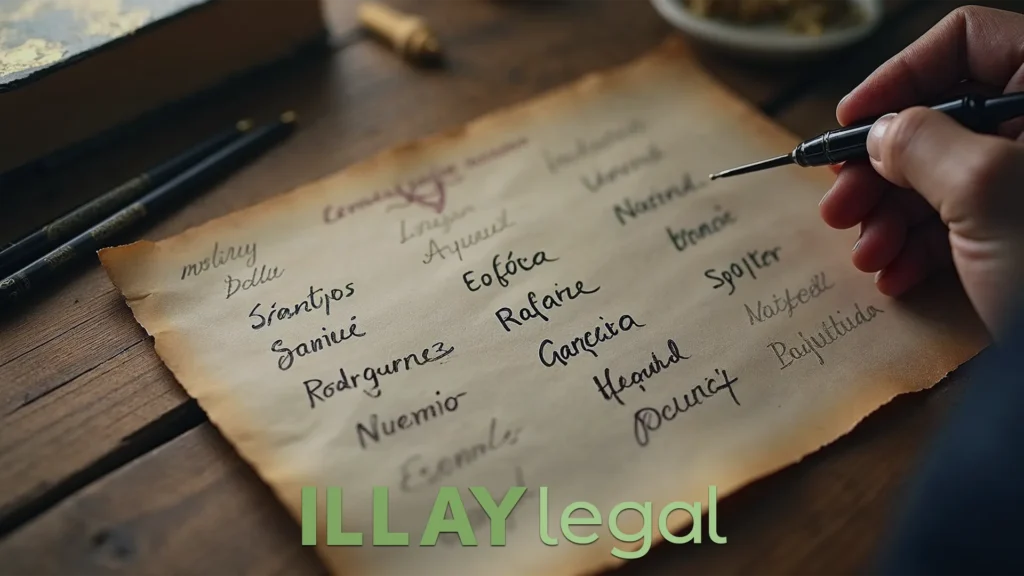
Have you received a list on WhatsApp or seen a video on TikTok claiming that if your last name is “Sánchez,” “Rodríguez,” or “García” you are automatically Spanish?
It is very likely that this information has sparked your hope, but I must be honest with you from the very first line: having a Spanish surname, by itself, does not give you the right to a passport. However, not everything is bad news; although Spanish nationality by surname as a direct procedure is a viral myth, that same surname can be the key clue to finding a legal path that actually works today.
In this guide, updated to February 2026, we dismantle the myth, explain where the confusion started, and walk you through every real legal route to Spanish citizenship that is currently open for people researching their Spanish roots.
Is there an official list of surnames to obtain Spanish citizenship?
Let’s kill the myth quickly so you don’t waste time or money on useless procedures. The Government of Spain has never published an official list of surnames that grant citizenship automatically. The lists circulating on the internet are compilations of surnames of Sephardic Jewish origin or simply common surnames in the peninsula, but they lack legal value on their own.
- The surname is just a genealogical indication, not legal proof of nationality.
- Massive surnames like “Pérez” or “López” are carried by millions of people with no direct connection to Spain in recent centuries.
- Beware of scams: mistrust any “agent” who promises you the passport solely based on your name in exchange for money.
Not in 2024, not in 2025, and not in 2026: no list has any legal value, regardless of how many websites share it.
The origin of the confusion: the Sephardic Law (Law 12/2015)
Where does so much noise come from then? The confusion stems from the famous Sephardic Law (Law 12/2015), a historic regulation that allowed descendants of Jews expelled in 1492 to apply for nationality. To do so, they had to prove their Sephardic origin through a complex process that included certificates from the Federation of Jewish Communities and culture exams, not just “having the surname.”
One of the ways to support (not prove on its own) the application was through the applicant’s surname. At that time, many online portals began publishing lists of Sephardic-origin surnames. However, the surname alone was never enough; it was just one element within a much larger set of requirements, including official reports from entities recognized by the Spanish authorities.
Although the law expired years ago, these lists have stayed online, misleading people into believing the surname itself grants nationality.
Important: The application deadline for this law ended on October 1, 2019 (with a limited operational extension). Today, that route is closed for new ordinary files, except for very complex residual cases by Letter of Naturalization, a discretionary and exceptional decision of the Council of Ministers that requires very robust documentary proof of links with Spain and Sephardic Judaism, not just a surname. In practice, it is extremely rare for such cases to succeed.
Spanish citizenship by descent: who qualifies at a glance
If your last name has led you to investigate your roots, the real question is not “is my surname on a list?” but “do I have a documentable ancestor who was Spanish?” Here is a quick overview of who can claim Spanish citizenship through family connections today:
| Route | Who qualifies | Status in 2026 |
|---|---|---|
| Through a parent (Spaniards by origin) | One parent was Spanish at your birth; both parents were born in Spain; or you were adopted by a Spanish citizen before age 18 | ✅ Open |
| Through a grandparent (nationality by option) | Grandchild of a Spanish citizen, especially if the intermediate generation had the right to nationality but did not exercise it | ✅ Open (with conditions) |
| Democratic Memory Law | Children and grandchildren of Spanish exiles | ❌ Closed (Oct. 22, 2025) |
| Sephardic Jewish descent | Descendants of Jews expelled in 1492 | ❌ Closed (Oct. 1, 2019) |
| Residence (Ibero-Americans) | Citizens from Latin America, Portugal, Andorra, Philippines, Equatorial Guinea — 2 years of legal residence | ✅ Open |
| Residence (grandchild of a Spaniard) | Grandchildren of Spanish citizens — only 1 year of legal residence | ✅ Open |
Now let’s explore the routes that are directly relevant if you’re here because of your surname.
If not by surname, how can I be Spanish today? (Real ways)
This is where we pivot from disappointment to action. If your surname has led you to investigate your roots, you might find a real ancestor who opens the doors of a current law. Forget the “Spanish nationality surname list 2025” and focus on these solid, legally valid options.
1. Nationality for Spaniards by origin (through a parent)
If one of your parents was a Spanish citizen at the time of your birth, you are likely already Spanish by origin; you simply need to register it officially. This is the most direct route and applies even if you were born abroad. It also covers:
- Children born in Spain to foreign parents if at least one parent was also born in Spain.
- Children adopted by Spanish nationals before the age of 18.
Being Spanish by origin is the strongest form of citizenship: it cannot be taken away from you. However, you can lose it if, while living abroad, you acquire another nationality and do not formally declare your wish to retain the Spanish one within three years (Article 24 of the Civil Code).
Many people with Spanish-sounding last names discover through research that their parent was, in fact, already entitled to Spanish nationality, which means they are too. This is where the surname starts working as the compass we mentioned.
2. Nationality by option (children and grandchildren in specific cases)
Nationality by option allows certain individuals with direct family links to Spain to acquire citizenship through a simplified procedure. This is particularly relevant if:
- Your parent had the right to claim Spanish nationality but never exercised it. In some cases, that right can transfer to you (the grandchild), although there are age and time restrictions that require professional assessment.
- You are the minor child of a foreigner who recently acquired Spanish nationality (it extends automatically).
- Your grandmother was a Spanish woman who lost her nationality because she married a foreign husband before the 1978 Constitution, a provision that specifically affected women and was later recognized as discriminatory.
This route is a quick path for those who, although not born Spanish, have a direct family link through filiation or adoption. If you suspect you might qualify, consult a specialist: the legal nuances are significant.
3. Democratic Memory Law (“Grandchildren Law”) — CLOSED since October 2025
This was the “star route” for several years. The Democratic Memory Law (Ley 20/2022), popularly known as the Grandchildren Law, allowed children and grandchildren of Spaniards, whether they were exiled or not, to obtain nationality. Here it did not matter if your last name was “Smith” or “González”; what mattered was the bloodline and documentary proof.
⚠️ Critical update (February 2026): The deadline to submit applications under this law was October 22, 2025. The Spanish government confirmed there would be no further extensions. Minister Ángel Víctor Torres stated publicly that there were no political or administrative conditions for a new extension.
This means:
- New applications are no longer accepted. Any request submitted after October 22, 2025 is automatically rejected.
- Applications submitted before the deadline are still being processed. Consulates — particularly in Argentina, Cuba, Brazil, and Mexico — are dealing with massive backlogs. Over 876,000 petitions were filed, and many will take months or even years to resolve.
- If you submitted your application on time, keep your registration receipt, monitor your email, and respond promptly to any consular requests for additional documentation.
However, the minister also acknowledged that “the law could be improved in the future with subsequent legislation.” So a future law expanding access is not impossible, though it would require new parliamentary majorities. For now, this route is closed.
4. Nationality by residence (the Ibero-American advantage)
If you are a citizen of an Ibero-American country (including Brazil, Portugal, Andorra, the Philippines, or Equatorial Guinea), you have a huge competitive advantage. The Civil Code reduces the general term of 10 years to only 2 years of legal and continuous residence in Spain to apply for nationality.
- You do not need to prove ancient lineage.
- Your surname is irrelevant; what counts is your passport of origin and your legal integration in the country.
And here’s a crucial detail that many people overlook: if you are the grandchild of a Spanish citizen (even if the Democratic Memory Law is closed), you can apply for nationality after just 1 year of legal residence in Spain. Your surname can’t prove this, but your grandparent’s birth certificate can.
5. Nationality by naturalization (Letter of Naturalization)
This is an exceptional procedure that can only be granted by the government through a Royal Decree. It is not an enforceable right but a “grace” granted at the government’s discretion, typically reserved for elite athletes, artists, researchers, or people with a special cultural connection to Spain.
For those with a Jewish surname wondering if this route applies to them: it is a theoretical possibility contemplated by the Civil Code, but in practice, it is extremely difficult. It requires very robust documentary proof of links with Spain and Sephardic Judaism, not just having a surname on a list. It is not a massive route and should not be relied upon as a realistic option.
6. Nationality by possession of state
An unusual but legally recognized route. This applies to those who, in good faith and for at least ten continuous years, have used and enjoyed Spanish status, for example, by holding a Spanish passport or ID card, being registered in the Civil Registry, or exercising rights and duties as a Spanish citizen.
The key requirement is that there must be a “title” registered in the Civil Registry (such as a passport, national ID, or civil registration) that motivated this continuous use. Without this documentary basis, Article 18 of the Civil Code cannot be applied.
This route can be relevant for people who have always believed they were Spanish (perhaps because of their surname and family traditions) but whose nationality was never correctly registered. If you can prove you acted as a Spanish citizen for a decade with official documentation, this path may consolidate what you already believed to be true.
Can I get Spanish citizenship through a great-grandparent?
This is one of the most common questions from people investigating their surnames, and the answer is clear: currently there is no direct legal route to obtain Spanish citizenship through a great-grandparent.
Spanish nationality law recognizes connections through parents and, in specific circumstances, grandparents, but it does not extend to great-grandparents. The Democratic Memory Law, which was the broadest route for descendants, also limited eligibility to children and grandchildren.
However, there is an indirect possibility: if your great-grandparent was Spanish, it is possible that your grandparent was also Spanish (or had the right to be). In that case, the connection might still work through the grandparent. This is precisely where investigating your surname and building your family tree can make all the difference.
How to prove your Spanish descent: a practical guide
So your last name has led you this far. You suspect there’s a Spanish ancestor, but suspecting and proving are very different things. Here is a step-by-step approach to turn your surname into legal evidence:
Start with family conversations
Talk to your parents, grandparents, aunts, and uncles. Ask about birthplaces, immigration dates, and any documents they might still have. Old passports, letters, photos, and identity cards can provide essential clues that no online database can replace.
Search civil and parish records
Spanish civil registries (Registro Civil) contain birth, marriage, and death records dating back to 1871. For earlier records, parish archives (Catholic Church records) are often the best source, with baptismal records going back centuries. Many of these are being digitized and can be accessed through the Spanish Ministry of Justice’s online portal.
Use online genealogy tools
Platforms like FamilySearch (free), Ancestry, and MyHeritage have extensive databases with Spanish records. They can help you trace immigration patterns and locate your ancestors’ birthplace in Spain.
Obtain the right documents
Once you find the key ancestor, you will need literal copies (not extracts) of their birth certificates from the relevant Spanish Civil Registry. These must be recent, typically issued within the last 3 to 12 months depending on the consulate. All documents must be apostilled (Hague Convention) and accompanied by a sworn translation (traducción jurada) into Spanish if they are in another language.
Consult a specialized immigration lawyer
If the documentation trail is complex or you’re unsure about your eligibility, a lawyer specialized in Spanish nationality law can save you considerable time and prevent costly mistakes. This is especially important for grandparent-based claims, where the legal nuances can determine the difference between success and a rejected application.
What to do now that the Democratic Memory Law has closed
If you arrived at this article hoping to apply through the Grandchildren Law, here is a clear action plan for 2026:
- If you submitted your application before October 22, 2025: your case is still being processed. Be patient, and keep your documentation updated.
- If you missed the deadline, focus on these alternatives:
- Nationality by option: if your parent had the right to Spanish nationality and didn’t claim it.
- Nationality by residence (1 year): if you can prove you are the grandchild of a Spaniard and are willing to move to Spain.
- Nationality by residence (2 years): if you hold a passport from an Ibero-American country.
- Watch for future legislation: the government has acknowledged the law could be revisited, though no concrete proposal exists yet and it would require new parliamentary majorities.
Surnames with history: what value do they have then?
I don’t want you to think your surname is worthless. It has immense historical and genealogical value. If you investigate the origin of your surname and build your family tree, you could discover that Spanish grandfather or great-grandfather you didn’t know about. That is the true utility: the surname is the compass, not the treasure.
Many surnames carry direct connections to specific regions in Spain: “Navarro” to Navarra, “Gallego” to Galicia, “Catalán” to Catalonia. Others, like “Cohen,” “Levi,” or “Toledano,” reflect Sephardic origins. And common surnames like “García,” “Martínez,” or “Rodríguez” may indicate Spanish lineage, but they are shared by millions across Latin America who may or may not have a direct, documentable connection.
Use ancestor search tools or parish archives to track baptismal certificates. If you find an ancestor born in Spain, you could qualify for nationality by option, by residence (with a reduced 1-year requirement as a grandchild of a Spaniard), or, in very exceptional cases of Sephardic descent proven documentarily (not just by name), explore the complex path of the Letter of Naturalization.
Do you think you might qualify for Spanish citizenship through your family roots? Our immigration law team can assess your specific case, review your documentation, and guide you through the right legal path — with up-to-date advice you can trust.
Frequently asked questions about surnames and passports
We compile the real doubts that reach our office due to viral videos, so you have the clear and direct answer.
Is the surname law for Spaniards still in force?
No, and a “surname law” as such never existed. The specific Law 12/2015 for Sephardim closed its deadline for admitting new applications years ago. Now only the files that were submitted on time and remained pending or appeals are being resolved.
My surname appears on the Sephardic list, what do I do?
Nothing automatic. That your surname appears on a website does not grant you rights. It serves as a cultural curiosity. To emigrate to Spain, you will need to process a visa for studies, work, or *arraigo*, or demonstrate direct filiation with a recent Spaniard (parents or grandparents).
Can I request nationality by Letter of Naturalization if I have a Jewish surname?
It is a theoretical possibility contemplated by the Civil Code, but in practice, it is extremely difficult. The Letter of Naturalization is a “grace” granted by the Government discretionarily. It is not a massive route nor an enforceable right, and it requires very robust documentary proof of links with Spain and Sephardic Judaism, not just a surname.
In short: do not believe everything you see on social media. Forget the magic list and look for your birth certificate or that of your grandparents; that is where your true opportunity lies. If you investigate your documents well, you might discover that you meet the requirements for Spanish nationality by surname (via real lineage) or residence, safe and legal options to obtain your passport.