Spanish citizenship by last name doesn’t exist: no surname, whether García, Rodríguez or one of Sephardic origin, entitles you to a Spanish passport on its own. If a list has reached you through WhatsApp or TikTok, we understand the hope, but no Spanish law treats your last name as a path to citizenship.
What can open the door is the person who gave you that name. If your father, your mother, a grandfather or a grandmother was Spanish and you can prove it with birth records, you have real options. That’s the kind of Spanish citizenship by descent the law recognizes.
Below you’ll find where the lists come from, which paths are still open, what happened to the Grandchildren Law and how to build your proof without mistakes.
In 30 Seconds
- There’s no surname list and no surname law: Spanish citizenship by last name is a myth, and the Spanish Civil Code doesn’t mention last names in any of its paths.
- The special programs for descendants have closed: the Sephardic route on October 1, 2019, and the Grandchildren Law on October 22, 2025.
- Parents and grandparents still count: through a Spanish parent you may be Spanish by origin or by option; through a grandparent, one year of legal residency in Spain is enough.
- The proof is a document, not a name: the full (literal) birth certificate of your Spanish relative.
What Spanish Citizenship by Last Name Is (and What It Isn’t)
“Spanish citizenship by last name,” also searched as Spanish citizenship by surname, is the viral idea that having a Spanish surname, or one that appears on a list, makes you eligible. It isn’t a legal path. Spanish law only recognizes descent, option, residency, naturalization by royal decree and possession of status.
It isn’t a shortcut for distant descendants either. The law protects your link to a specific Spanish person, and that link is proven with civil records. Two people named Fernández can be in opposite situations: one has a grandfather born in Oviedo, and the other has no Spanish ancestor they can document.
Is There an Official Spanish Citizenship by Last Name List?
No. No Spanish law contains a surname list, so any Spanish citizenship by last name list you find online has no legal value. Those lists mix surnames that are common in Spain and Latin America with old Sephardic compilations. Seeing yours on one doesn’t give you any right or speed up any process, and that’s the honest answer to how to claim Spanish citizenship by last name: you can’t.
Where the Lists Come From: Sephardic Surnames and Law 12/2015
The lists grew out of Law 12/2015, which opened a special route for Sephardic Jews in which a surname was just one clue among many.
That law, in force from October 1, 2015, allowed descendants of the Jews expelled from Spain to apply without living there. In exchange, they had to prove Sephardic origin and a special connection to Spain, pass the Instituto Cervantes exams and appear before a notary in Spain.
Origin was proven with a set of documents, such as certificates from the Federation of Jewish Communities of Spain or the use of Ladino. A report on the applicant’s surnames was one more piece of evidence, never enough on its own. Because many websites published lists of Sephardic surnames, people came to believe the name alone was enough.
The deadline, extended by one year, closed on October 1, 2019, with 132,226 applications, according to Spain’s Ministry of Justice.
Is There a List of Sephardic Surnames Eligible for Spanish Citizenship?
No, and the special Sephardic route itself is closed. Two options remain, and neither depends on a list of Sephardic surnames eligible for Spanish citizenship. The first is the shorter two-year residency the Civil Code gives people of Sephardic origin, which requires living legally in Spain and proving that origin. The second is naturalization by royal decree (Carta de Naturaleza), which the Government grants at its discretion and only in exceptional circumstances.
Spanish Citizenship by Descent: The Real Paths Through Parents and Grandparents
Today, Spanish citizenship by descent runs through a specific parent or grandparent, or through one or two years of legal residency in Spain.
These are the paths in the Spanish Civil Code that matter to you:
| Path | Who | Where | Time or limit | Article |
|---|---|---|---|---|
| By origin | Your father or mother was Spanish when you were born | Consular Civil Registry | You’re already Spanish; you register | 17.1.a |
| By option | Your father or mother was Spanish by origin and born in Spain | Consular Civil Registry | No age limit | 20.1.b |
| By option | You are or were under the parental authority of a Spaniard | Consular Civil Registry | Generally until age 20 | 20.1.a |
| By residency | You were born abroad and a parent or grandparent was originally Spanish | Spain | 1 year of legal residency | 22.2.f |
| By residency | Nationals of Ibero-American countries, Andorra, the Philippines, Equatorial Guinea or Portugal, and Sephardic Jews | Spain | 2 years of legal residency | 22.1 |
| Possession of status | You’ve used Spanish nationality in good faith, based on a registered title | Civil Registry | 10 years of continuous use | 18 |
For most U.S. citizens without Spanish ancestry, the general residency requirement is ten years, so a Spanish grandparent can make a big difference.
1. Child of a Spaniard: Spanish Citizenship by Origin
If your father or mother was Spanish when you were born, you’re Spanish by origin even if you were born in Houston or Manila. You don’t apply for citizenship: you register your birth with the consular Civil Registry. We cover the details on our page about Spanish citizenship by origin.
Watch out for one detail. Say you and your Spanish parent were both born abroad, and your country also gave you its nationality. In that case, you had three years from adulthood to declare that you wanted to keep Spanish nationality. If you didn’t, you lost it, although you can recover it without living in Spain.
2. Parent Born in Spain: Spanish Citizenship by Option
If your father or mother was born in Spain and was Spanish by origin, you can opt for citizenship at any age. It doesn’t matter if they lost it before you were born, like an emigrant who naturalized in a new country. Anyone who is or was under the parental authority of a Spaniard can also opt, generally until age 20.
Spanish citizenship by option is filed in person with the Civil Registry, free of charge. It ends with an oath or promise of loyalty to the King and obedience to the Constitution and the laws.
3. Grandchild of a Spaniard: Citizenship After One Year of Residency
If you were born outside Spain and your grandfather or grandmother was originally Spanish, you can apply after one year of legal, continuous residency in Spain. It’s the real answer to how to get Spanish citizenship by descent through a grandparent now that the Grandchildren Law has closed. You’ll need a residence authorization first; our page on Spanish citizenship by residency explains the process.
Here’s an example with numbers. Daniel is 38 and lives in Miami. His grandmother was born in Vigo in 1931 and became a U.S. citizen in 1958, before Daniel’s father was born. If she lost Spanish nationality at that point, which has to be checked against the rules of the time, Daniel’s father wasn’t born Spanish.
Even so, his father can opt at any age, because his mother was born in Spain. Daniel, as an adult, can’t benefit from that option. His path is one year of legal residency in Spain instead of the ten he’d need as an American without a Spanish grandparent.
Can I Claim Spanish Citizenship if My Great-Grandfather Was Spanish?
Only indirectly, because no current path goes beyond grandparents. But nationality passes from parents to children. If your great-grandfather was Spanish when your grandfather was born, your grandfather was born Spanish, and if no one lost it along the way, the chain can reach you. It has to be checked generation by generation, under the rules of each period.
4. Possession of Status: Ten Years Using Spanish Nationality
If you’ve used Spanish nationality for ten straight years, in good faith and based on a title registered with the Civil Registry, it becomes consolidated. That holds even if the title that created it is later annulled. Without a registered title, it doesn’t apply.
The Grandchildren Law: Closed Since October 22, 2025
The Democratic Memory Law, known as the Grandchildren Law, stopped accepting appointment requests on October 22, 2025, at 11:59 p.m.
It allowed three groups to opt for citizenship. First, people born abroad to parents or grandparents who were originally Spanish and went into exile. Second, children of Spanish women who lost their nationality by marrying a foreigner before 1978. Third, adult children of people who recovered their nationality under that law or under Law 52/2007.
Its reach was huge. As of May 31, 2026, consulates had received 1,225,188 applications, approved 571,761 and completed 333,696 registrations, according to Spain’s Ministry of Foreign Affairs.
If you requested an appointment on time, your file moves forward: keep the receipt showing you made the deadline, because the consulate will ask for it. We walk through each stage in our guide on the status of Grandchildren Law applications. If you missed it, review the paths above: many grandchildren now have the one-year residency route.
How to Prove Spanish Descent for Citizenship, Step by Step
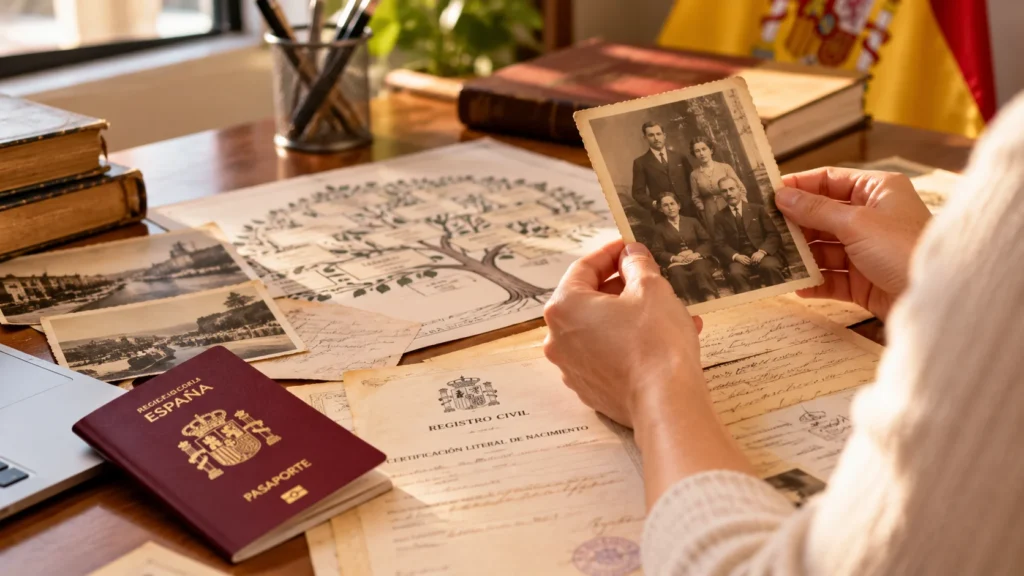
You prove it with a chain of civil records linking your birth to your Spanish relative’s, with no gaps and with details that match.
How Do I Know if I Have Spanish Ancestry?
Start with your family and your own country’s records, not with your surname. Ask where your parents and grandparents were born, and look for old passports, naturalization certificates or marriage records. Birth certificates from each generation usually show where the parents were born. If someone was born in Spain, you have a lead.
- Identify your Spanish relative, with their full name and the place and approximate year of birth.
- Request their full (literal) birth certificate through the Spanish Ministry of Justice e-portal. It must be the literal version, not an extract.
- Gather each generation’s records, both births and marriages, from that person down to you.
- Check that names and dates match across every record.
- Apostille your country’s documents and get a sworn translation of anything not in Spanish.
- Choose your path and book an appointment with the consular Civil Registry, or plan your residency in Spain.
Summary of the Steps
- Identify your Spanish relative.
- Request their literal birth certificate.
- Gather each generation’s records.
- Check that the details match.
- Apostille and translate if needed.
- Choose your path and book an appointment.
Spanish Citizenship by Last Name: Mistakes and Scams to Avoid
The costliest problems don’t come from the law. They come from paying for shortcuts that don’t exist or filing documents that prove nothing.
- Paying for a surname process: it doesn’t exist, so be wary of anyone who promises a passport based on your last name in exchange for money.
- Filing an extract: the consulate asks for your Spanish relative’s literal birth certificate.
- Records that don’t match: a surname spelled two ways or a different date can stall your file until it’s sorted out.
- Mixing up a Spanish grandparent and one born in Spain: the option requires a parent born in Spain; the one-year residency only requires a grandparent who was originally Spanish.
- Forgetting the declaration to keep it: if you’re the child of a Spaniard and you were both born abroad, check whether you declared in time.
Put simply: before you pay anyone or book an appointment, confirm which path fits you and which document proves it.
What Your Surname Is Good For
Your surname won’t give you Spanish citizenship, but it can be the clue that leads you to the relative who can.
Knowing the list is a myth is only half the answer. The other half is finding out whether your family leaves you a path open, and which one. At ILLAY Legal, we review your family tree document by document and tell you whether you fit the origin, option or residency path. Then we prepare your file with you, 100% online and in your language. Tell us who in your family was born in Spain, in what year and which documents you have, and we’ll tell you which path you have and where to start.
Frequently Asked Questions About Spanish Citizenship by Last Name
How long will it take to get Spanish citizenship?
It depends on your path. If you’re Spanish by origin, there’s nothing to wait for before applying: you register your birth. The option can also be filed right away if you qualify. By residency, you first need one year of legal residency as a grandchild of a Spaniard. It’s two years for Ibero-American and Filipino nationals and ten in most other cases. After you apply, processing time varies by office and by case, so plan for a wait.
Can Filipinos get Spanish citizenship by last name?
No. Many Filipino surnames are Spanish for historical reasons tied to the colonial period, not because of Spanish ancestry, and the law gives them no legal weight. Filipinos do have an advantage, though: like Ibero-American nationals, they can apply after two years of legal residency in Spain instead of ten. And if a Filipino has a Spanish parent or grandparent, the paths by origin, option or one-year residency apply just as they do for anyone else.
Are common Hispanic last names like García or Hernández Spanish?
Many of them originated in the Iberian Peninsula, but that has no legal effect. They arrived centuries ago and millions of people in the Americas carry them without any Spanish relative they can document. What counts is whether your parent or grandparent was Spanish and whether you can prove it.
Is there a Spanish citizenship test?
Only for the residency path. Registering as the child of a Spaniard or opting for citizenship involves no exam. By residency, including a grandchild’s one-year route, you must pass the CCSE, the Instituto Cervantes test on the Spanish Constitution and society. U.S. citizens generally also need the DELE A2 Spanish exam, since only nationals of the Spanish-speaking countries listed in Order JUS/1625/2016 are exempt. Applicants under 18 are exempt from both.
Can I hold dual Spanish citizenship as an American?
It depends on how you become Spanish. If you’re Spanish by origin through a parent, you don’t acquire anything: you’ve been Spanish since birth. If you acquire it by option or residency, Spain asks you to declare that you renounce your previous nationality, because the U.S. isn’t on its list of exempt countries. How the U.S. treats that declaration is governed by U.S. law, so confirm it with the State Department.
My grandmother lost her Spanish citizenship by marrying a foreigner. Is there still a path?
Yes, although the Grandchildren Law route for this case has closed. If your grandmother was born in Spain and was Spanish by origin, her child, your father or mother, can opt for citizenship at any age. You, as a grandchild born abroad, can apply after one year of legal residency in Spain. And if your grandmother is alive, she can recover her nationality without having to live in Spain. In every case, the chain must be proven with literal birth certificates.
Do I need a lawyer for Spanish citizenship through my grandparents?
It isn’t mandatory. Filing by option or registering a birth with the Civil Registry is free, and you can file a residence-based application yourself. A lawyer mainly saves you from two costly mistakes: choosing a path that doesn’t fit your case and filing a chain of documents with gaps. If your family has spent several generations outside Spain, or someone lost their nationality along the way, it’s worth having a specialist review it before you book an appointment.