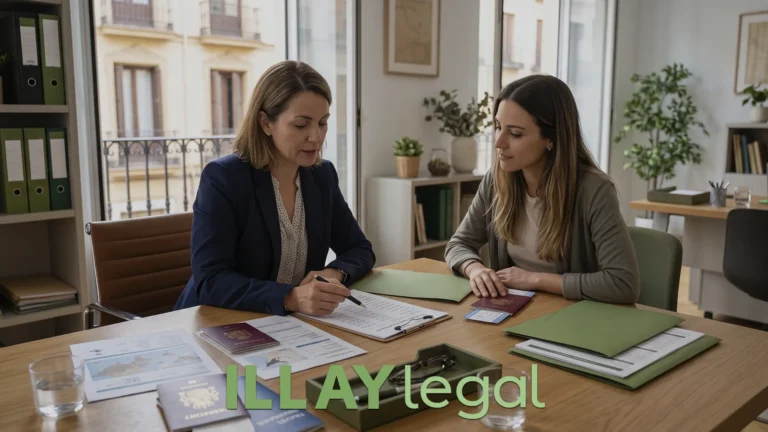
Are you interested in obtaining Spanish nationality? This is a crucial step for those who wish to settle in Spain permanently and enjoy all the rights and benefits of being a Spanish citizen. However, the process can be complex, as there are several ways to obtain it, each with its own specific requirements and processing times.
Obtaining Spanish nationality can be done through different procedures and each of these options has its own conditions and waiting times, so it is essential to know them thoroughly in order to choose the most appropriate one for each personal situation.
In this guide, we explain in detail everything you need to know about Spanish nationality and we also offer valuable information on the importance of legal assistance to ensure a successful application.
Table of contents:
Do you want a expert consultation? Contact us and we will help you.
What is Spanish nationality and how is it acquired?
Spanish nationality is the legal bond that unites a person with Spain, granting them all the rights and duties of a citizen. Obtaining nationality means that the person can live and work in Spain without restrictions, access public health and education, vote in elections and obtain a Spanish passport, considered one of the most powerful in the world.
There are different ways of acquiring Spanish nationality, depending on the personal situation of the applicant. The most common ways include:
- By residence: This is granted to people who have lived legally in Spain for a certain period of time, fulfilling the established requirements.
- By origin: This is automatically granted to children of Spanish parents or to people born in Spain under specific conditions.
- By letter of naturalization: An exceptional procedure in which the Government grants nationality for special reasons, such as cultural, scientific or humanitarian merits.
- By option: Available to descendants of Spaniards or people adopted by Spanish citizens, allowing them easier access to nationality.
Each of these options requires a different process and the fulfillment of certain legal requirements. In most cases, the applicant must present documentation, demonstrate integration into Spanish society and pass certain exams.
What is the difference between residence and nationality in Spain?
Many people confuse legal residence with Spanish nationality, since both allow them to live in Spain. However, there are important differences between the two:
- Residence permit: This allows foreigners to live and work in Spain legally, but it is subject to certain conditions and periodic renewals.
- Nationality: This grants the person all the rights of a Spanish citizen, including the right to vote in elections, obtain a Spanish passport and reside freely in any country of the European Union.
A person with residence in Spain continues to be a citizen of their country of origin and must renew their residence permit according to the deadlines established by law. On the other hand, by obtaining Spanish nationality, one acquires a permanent legal status without the need for renewals or additional permits.
How to obtain Spanish nationality: the 3 main options
Acquiring Spanish nationality is a process that varies according to each person’s situation. Spain offers different ways to obtain nationality, each with its own requirements and waiting times. It is important to know which option is most appropriate for each individual case, as this will influence the duration and the procedures necessary to complete the process.
Below, we analyze the three most common options for obtaining Spanish nationality: by residence, by origin or birth, and by carta de naturaleza (letter of naturalization).
1. Nationality by residence
Nationality by residence is the most common route for foreigners who have lived legally in Spain for a certain period of time. This option is based on the number of years a person has resided in the country continuously and with a valid legal permit.
The required periods of residence vary according to the nationality and personal circumstances of the applicant:
- 10 years for most foreigners.
- 5 years for refugees with recognized status in Spain.
- 2 years for citizens of Latin American countries, Andorra, the Philippines, Equatorial Guinea, Portugal and people of Sephardic descent.
- 1 year for:
- People born in Spain who have resided in the country for at least one year.
- Spouses of Spanish citizens (provided they are not legally separated).
- Widows/widowers of Spaniards (if they were not separated at the time of death).
- Direct descendants of Spaniards (children or grandchildren of citizens of Spanish origin).
In addition to the residence requirement, it is mandatory to meet other criteria:
- Pass the nationality exams:
- The CCSE (Conocimientos Constitucionales y Socioculturales de España) assesses the applicant’s knowledge of Spanish culture, history and legal system.
- DELE (Diploma de Español como Lengua Extranjera): Compulsory only for those who do not have Spanish as their mother tongue.
- Demonstrate good civic conduct: The applicant must have no criminal record in Spain or in their country of origin.
- Prove stable financial means: In some cases, the applicant must prove that they have sufficient resources to support themselves in Spain.
The application for nationality by residence is submitted to the Ministry of Justice, and the process can take between one and three years depending on the administrative workload and whether the documentation has been submitted correctly.
2. Nationality by origin or birth
Nationality by origin or birth is granted automatically to certain people without the need to comply with the residence periods. It is mainly intended for those who have a direct family link with Spanish citizens.
It is granted in the following cases:
- Children of a Spanish father or mother, regardless of where they were born.
- People born in Spain whose parents are stateless (without nationality) or whose national legislation does not confer citizenship on them.
- Persons born in Spain to foreign parents who have no right to another nationality and are legally resident in Spain.
- Persons adopted by Spanish citizens.
In these cases, the application process is usually faster than that of nationality by residence, as it does not require additional exams or tests. However, it is necessary to present documentation proving the family relationship with the Spanish citizen.
3. Nationality by letter of nature
Nationality by letter of nature is an exceptional procedure granted by the Spanish Government to people who have demonstrated relevant merits in areas such as:
- Culture and art: Writers, musicians, artists or people who have contributed significantly to Spanish culture.
- Science and research: Scientists or researchers with outstanding achievements that benefit Spain.
- Sport: Elite athletes who have represented or can represent Spain in international competitions.
- Humanitarian reasons: People who have lived in situations of risk or vulnerability and whose integration into Spain is considered to be of special interest.
The granting of nationality by this route does not follow the regular deadlines of the other options and is at the discretion of the Council of Ministers, which decides on a case-by-case basis.
This type of nationality is less common and its approval depends directly on the will of the Government, without the need to comply with specific residence requirements.
Do you want a expert consultation? Contact us and we will help you.
Documentation and requirements for Spanish nationality
Applying for Spanish nationality requires the presentation of a series of essential documents. Each route to obtaining nationality has its own specific requirements, but in general, there are certain documents that are mandatory for all applications.
It is essential to present all documentation without errors or omissions to avoid delays in the processing of the application. The most important requirements and documents are detailed below.
Valid passport and NIE
A valid passport is essential to prove the identity and nationality of the applicant. The Foreigner Identity Number (NIE, for its Spanish initials) must also be presented. This is the identification number assigned to foreigners residing in Spain.
Certificate of legal residence in Spain
This document certifies the length of time the applicant has resided in Spain and is issued by the Foreigners Office or the National Police. It is key for nationality by residence, as it must demonstrate that the minimum required period has been fulfilled.
Certificate of criminal record
Both a certificate of criminal record from the country of origin and one issued by the Spanish authorities are required. This document demonstrates that the applicant has good civic conduct, an essential requirement for obtaining nationality.
Spanish nationality exams
For those applying for nationality through residency, it is compulsory to pass two tests organized by the Cervantes Institute:
- CCSE: Multiple choice exam on Spanish culture, society and laws.
- DELE (Diploma de Español como Lengua Extranjera) level A2 or higher: Only necessary for those who do not have Spanish as their mother tongue.
Proof of means of support or income in Spain
In some cases, it must be demonstrated that the applicant has sufficient economic resources to support themselves in Spain. This may include:
- Employment contract and most recent payslips.
- Income tax returns.
- Proof of income for the self-employed or business owners.
- Proof of sufficient savings if applying for nationality without employment.
Payment of the administrative fee
The application for Spanish nationality requires the payment of an administrative fee, the amount of which is updated periodically. The payment must be made using Form 790 Code 026 and submitted together with the application.
How to apply for Spanish nationality?
Applying for Spanish nationality involves following an administrative process that can be done in different ways. It is important to know each one of them in order to choose the most convenient one and avoid unnecessary delays in the process.
There are three main ways to apply for Spanish nationality:
1. Online application
The Electronic Office of the Ministry of Justice allows you to submit your application 100% online, making it the fastest and most efficient option.
To do so, you will need a digital certificate, which can be obtained from the Fábrica Nacional de Moneda y Timbre (FNMT) or through other recognized electronic means.
Steps to submit the application online:
- Access the Electronic Office of the Ministry of Justice.
- Fill in the application form with your personal details.
- Attach the required documentation in PDF format.
- Pay the corresponding administrative fee.
- Send the application and save the receipt.
2. Application through the Civil Registry
If you prefer to do the paperwork in person, you can submit the application at the Civil Registry office corresponding to your address in Spain.
However, this method can be slower, as many offices have long waiting lists for applications.
Steps to process nationality at the Civil Registry:
- Make an appointment at the Civil Registry in your locality.
- Go on the assigned date with all the original documentation and copies.
- Hand in the paper application to the official in charge.
- Receive a file number to follow up the process.
- This method is recommended for those who do not have access to a digital certificate and prefer to do the process with face-to-face assistance.
3. Application through a specialized lawyer or agent
If you want to avoid mistakes and make sure that your application is submitted correctly, you can choose to seek the help of a lawyer specialized in immigration or an administrative agent.
Professionals in this area can:
- Review your documentation to make sure it is complete and error-free.
- Submit the application electronically on your behalf.
- Actively follow up on the file and notify you of any developments.
- Lodge appeals in case of delay or rejection of the application.
- This option is especially useful if you have questions about the process or if you want to avoid complications.
How long does it take to obtain Spanish nationality?
The waiting time to obtain Spanish nationality varies depending on the route by which it is applied for and the administrative workload at any given time. There is no exact deadline, but there are estimates based on experience in recent years.
- Nationality by residence: 1 to 3 years, depending on the workload of the Ministry of Justice. If the file is well presented and without errors, the period is usually shorter.
- Nationality by letter of naturalization: It can take months or even years, as each case is studied individually. It does not follow a standard procedure and the granting is at the discretion of the Council of Ministers.
- Nationality by option or descent: Generally less than 1 year, as it does not require meeting residency deadlines. In many cases, the process is resolved in about six months if the documentation is in order.
Obtain Spanish nationality and manage to establish yourself in Spain legally
Having Spanish nationality offers multiple benefits, but the process can be long and detailed. To achieve it successfully, it is essential to:
- Choose the appropriate route for your case (residence, origin or letter of naturalization).
- Prepare the documentation accurately to avoid delays.
- Follow the official times and deadlines so as not to miss opportunities.
- Carry out the procedure by the fastest route, preferably online.
- Seek legal advice if necessary to ensure that the whole process is carried out correctly.
If you want to avoid mistakes and guarantee that your application is processed without problems, having an expert in immigration matters can be the key to obtaining your Spanish nationality as quickly and efficiently as possible. If you need help to obtain your Spanish nationality, do not hesitate to write to us, our professionals are ready to provide you with the best service.
Do you want a expert consultation? Contact us and we will help you.
Disclaimer: This article is for informational purposes only and may contain errors or be outdated. It does not constitute legal advice. For an updated initial consultation, contact us. One of our expert attorneys will assist you.