The Spanish citizenship oath, known in Spain as the jura de nacionalidad, is the last step to becoming Spanish. Once you’re notified of your approval decision, you have 180 days to swear or promise loyalty to the King and obedience to the Constitution and the laws. At the same appointment, you renounce your previous nationality if required and request registration with the Civil Registry. Until that registration happens, you’re still a foreign national.
The clock starts with the notification, so you need to request your appointment early. That’s why problems rarely happen on the day of the oath itself. They happen earlier, when people miscount the days or request the appointment too late. The good news is that an appointment requested within the deadline protects your approval, even if the date you’re given falls later.
This guide covers the deadline, where to take the oath, how to book the appointment, which documents to bring, what happens with your children, and the steps until you have your DNI and passport. If you’re still at the application stage, start with our page on Spanish citizenship by residency.
In 30 Seconds
- You have 180 days: they run from the day after you’re notified, and an appointment requested within that window is valid even if it’s scheduled later.
- Two options in Spain: the Civil Registry for the address in your file, by appointment, or a notary, with no Registry appointment needed.
- Three acts in one: at the Spanish citizenship oath you swear or promise, renounce your nationality unless your country is exempt, and request registration.
- Afterward: you’re Spanish from the moment you’re registered, and with your birth certificate you apply for your DNI and then your passport.
What Is the Spanish Citizenship Oath (and What It Isn’t)
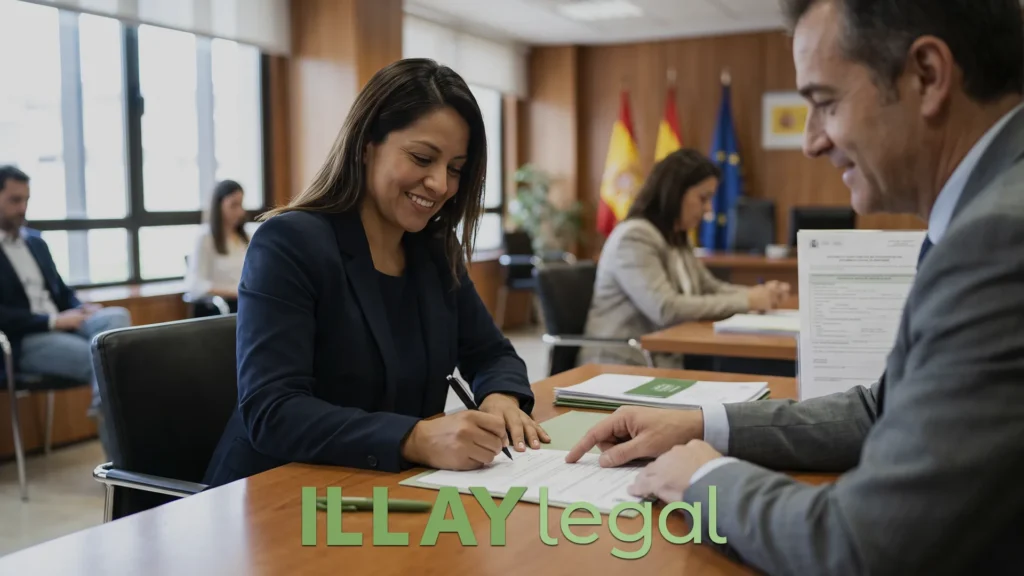
The Spanish citizenship oath is the formal act in which a person granted Spanish nationality swears or promises loyalty to the King and obedience to the Constitution and the laws. In the same act, they renounce their previous nationality when the law requires it and request registration with the Civil Registry.
It isn’t an exam or an interview: the tests and requirements of your application are already behind you. It isn’t the approval either, which you already have, and it has nothing to do with the military flag oath. It’s a formality, but don’t take it lightly: if it isn’t done on time, your approval expires.
Article 23 of the Civil Code sets three requirements, all met in the same act:
- Oath or promise: made in person by anyone aged 14 or older.
- Renunciation of your previous nationality: nationals of Ibero-American countries, Andorra, the Philippines, Equatorial Guinea, and Portugal don’t have to renounce, and neither do Sephardic Jews of Spanish origin. Since April 1, 2022, under the dual nationality agreement with France, French nationals are also exempt.
- Registration with the Civil Registry: this is what actually makes you Spanish, because registration is what grants the nationality.
If your country isn’t on that list, the renunciation takes effect in Spain; what your home country does with your nationality depends on its own law. We explain it in our guide to dual nationality.
What Is the Spanish Citizenship Oath Text?
You swear or promise loyalty to the King and obedience to the Constitution and the laws. The Spanish citizenship oath text comes word for word from Article 23 of the Civil Code (in Spanish, “fidelidad al Rey y obediencia a la Constitución y a las leyes”). Swearing and promising have the same legal value: promising is the option for anyone who prefers not to take an oath. You then declare your renunciation, if it applies, and sign the record or the notarial deed.
The 180-Day Deadline: When It Starts and What Protects It
You have 180 days to appear, counted from the day after you’re notified of the approval; if you don’t, the approval expires.
The decision is notified by postal mail or through Spain’s Single Enabled Electronic Address (DEHú); the email you get is only an alert. In DEHú, you’re considered notified when you open it or, if you don’t, 10 calendar days after it becomes available. If you’re not sure whether you’ve been notified yet, you can check the status of your application.
Here’s an example with sample dates: your decision becomes available in DEHú on March 2, and you don’t open it. You’re considered notified on March 12, so the 180 days start on March 13 and end on September 8. Count calendar days, including weekends and public holidays: it’s the safe way to calculate.
Watch out for one detail: what protects your approval is requesting the appointment on time, not having the appointment on time. The Ministry of Justice makes this clear in its Nationality Department FAQ (in Spanish). An appointment granted within the 180 days is valid even if its date falls later, and proof that you requested it pauses the deadline until a slot is available. Keep that proof. If you go to a notary, your request to the notary within the deadline also suspends it.
What Happens If I Don’t Take the Oath Within 180 Days?
Your approval expires. Article 21.4 of the Civil Code says so for residency-based approvals, and the Code doesn’t provide for extensions. If you’re a few days from the limit with no appointment, or the deadline has already passed, talk to a lawyer as soon as possible so they can review your case. Anyone who promises a guaranteed fix without seeing your file is oversimplifying.
Where to Take the Oath: Civil Registry, Notary, or Consulate
In Spain, you take the oath before the Civil Registry for the address in your file or before a notary. The law also mentions consulates, but Spain’s Ministry of Foreign Affairs states that consulates don’t process residency-based citizenship.
All three options appear in Article 68.3 of Law 20/2011 on the Civil Registry. At the Civil Registry, the oath is done by appointment, at the office for that address.
| Option | Good to Know |
|---|---|
| Civil Registry | By appointment, at the Registry for the last address in Spain shown in your file |
| Notary | No Registry appointment needed; your request suspends the deadline |
| Consulate | Allowed by law, but according to Foreign Affairs, consulates don’t process residency-based citizenship |
Can I Take the Spanish Nationality Oath Before a Notary?
Yes. Taking the Spanish nationality oath before a notary has been a voluntary alternative to the Civil Registry since 2021. It’s governed by an instruction from the Directorate General for Legal Certainty and Public Faith (DGSJFP) dated December 22, 2021. The notary must be the one for the address shown in your decision. They record the oath or promise, your renunciation, your surnames, and your vecindad civil in a notarial deed and send a copy to the Civil Registry so it can register your nationality.
In practical terms: if your Registry has appointments well within your deadline, you don’t need a notary; if time is tight, it’s usually the easier route, though it comes at a cost.
How to Book Your Oath Appointment in Each Region
You book the appointment on your region’s justice e-portal or, in the territories run by the Ministry of Justice, on the Ministry’s e-portal. The Ministry’s Nationality Department doesn’t give oath appointments.
| Region | Where to Book | Good to Know |
|---|---|---|
| Castilla-La Mancha, Castilla y León, Extremadura, Balearic Islands, Murcia, Ceuta, and Melilla | Ministry of Justice e-portal | Choose the office first, then the procedure from the drop-down menu |
| Madrid Region | Madrid Civil Registries | The Single Civil Registry only applies if you filed there, or filed online and live in the city of Madrid |
| Catalonia | Catalan justice e-portal | You need the CSV verification code on your decision; each person books their own appointment |
| Basque Country | Justizia | Usually two appointments: one for documents and one for the oath |
| Andalusia | Andalusian Government | The system includes nationality oaths |
| Galicia | Xustiza | The appointment system includes the oath |
| Canary Islands | Canary Islands Civil Registry | A dedicated section for nationality oaths |
| Aragon | Aragon justice e-portal | A dedicated page on the oath |
| Valencia Region and Navarre | Valencia Region · Navarre | Check which procedures your office offers |
| Asturias, Cantabria, and La Rioja | Your region’s justice e-portal | Look for the Registry for the address in your decision |
A tip that can save you weeks: request the appointment as soon as you’re notified, even if you’re still missing a document. The proof that you requested it is what protects your deadline, and the date you’re given may be far off. If no slots show up in your region’s system, take a dated screenshot of every attempt. And if you can’t even register the request, a notary is the safest way out.
Documents and Forms for the Spanish Oath of Citizenship
You always need your approval decision and your ID; everything else depends on the Registry and on how you filed. These are the documents usually requested for the Spanish oath of citizenship, but the list varies by region, so check it with your office.
| Document | When It’s Usually Requested |
|---|---|
| Approval decision, with its CSV verification code | Always |
| Passport and NIE or TIE (Foreigner Identity Card), originals | Always, to identify you |
| Full birth certificate, legalized or apostilled, with a sworn translation | If the Registry doesn’t already have the checked original, for example when you applied online |
| Criminal record certificate from your home country | At Registries such as those in Catalonia (except for minors) and Galicia, and in the Basque Country if you applied online |
| Recent municipal registration certificate (empadronamiento) | At Registries such as those in Catalonia (no older than 6 months), the Basque Country, Galicia, and the Canary Islands, and at the notary if you’ve moved |
| Data declaration form | Depends on the office: filled in beforehand or handed out at the appointment |
If you don’t have your municipal registration certificate, request it early. One more point that saves trouble: the documents you already filed with your application, such as your birth certificate or criminal record certificate, don’t need to be current. A March 2021 circular from the DGSJFP makes this clear.
Watch out for translations: your birth certificate must be legalized or apostilled and, if it isn’t in Spanish, come with a sworn translation. If it’s from an EU country, Regulation (EU) 2016/1191 exempts it from the apostille and, with the EU multilingual standard form, from translation too.
What Is the Oath Declaration Form?
It’s the sheet where you declare the details you’ll be registered with as a Spanish citizen: your first name, your surnames, and your parentage. Catalonia has its own form, which you bring filled in and signed, and in the Basque Country you get it at the appointment; ask your office or notary which one they use. Double-check your first name: you can register up to two simple first names or one compound name.
The Spanish Citizenship Oath Process, Step by Step
- Note the notification date and work out day 180.
- Choose your route: Civil Registry or notary.
- Request the appointment and keep the proof.
- Gather your documents and fill in your office’s form.
- Appear in person: swear or promise, renounce if required, choose your surnames and vecindad civil, and sign.
- Wait for your nationality to be registered with the Civil Registry.
- Receive your Spanish birth certificate, which now shows your nationality.
- Book your DNI appointment and, once you have the DNI, your passport.
Summary of the Steps
- Work out the last day of your 180 days.
- Choose Civil Registry or notary.
- Request the appointment and keep the proof.
- Prepare your documents and form.
- Swear or promise, renounce if required, and sign.
- Wait for registration and your birth certificate.
- Get your DNI and then your passport.
Your vecindad civil is the regional civil law status that decides which civil law applies to you, for example in an inheritance. Under Article 15.1 of the Civil Code, you can choose the one for where you live or where you were born, the last one held by either parent or adoptive parent, or your spouse’s.
Your Surnames as a Spanish Citizen
You’re registered with the surnames that apply under your parentage and Spanish law. If you use a different form in your home country, you can keep it by declaring so at the oath or within the following 2 months. Article 56 of the Civil Registry Law allows this, unless that form goes against public policy. If you only have one surname, under the Directorate General’s guidance it’s doubled: a woman registered at home as Ana Silva would become Ana Silva Silva.
Minors and Families: Who Takes the Oath
Children under 14 don’t take the oath or renounce anything: their legal representatives act on their behalf. Those aged 14 to 17 take it themselves, assisted by their legal representative.
Here’s how it works in practice: a family with a 15-year-old daughter and a 9-year-old son, all approved. Each parent takes the oath for themselves. The daughter takes it assisted by her legal representative; in Catalonia, both parents must accompany her, and if one lives abroad, they’ll need a special power of attorney signed before a notary. Nobody swears for the 9-year-old: his parents accept the nationality on his behalf and choose his surnames and vecindad civil.
People with disabilities act with whatever support they need, as Article 21.3 of the Civil Code provides. If you’re still applying for your children, you’ll find the details in our guide to Spanish citizenship for minors.
After the Spanish Citizenship Oath Ceremony: Registration, DNI, and Passport
You’re Spanish from the moment your nationality is registered; from there, with your birth certificate, you apply for your DNI and then your passport.
To get your DNI for the first time, the National Police will ask for the following, as set by Royal Decree 255/2025 and the Ministry of the Interior:
- Full birth certificate: issued “for DNI purposes only” and no older than 6 months.
- Municipal registration certificate: no older than 3 months.
- Recent photo: 32 by 26 millimeters.
- Your TIE or your EU registration certificate: the Ministry of the Interior lists it as an essential requirement.
Once your DNI is valid, you can apply for your passport. As a Spanish citizen, your ID document is now the DNI.
One point worth knowing early: if you had to renounce your previous nationality, don’t use it as your only nationality for 3 years. Under Article 25.1.a of the Civil Code, someone who isn’t Spanish by origin can lose Spanish nationality in that case.
If You Work in Spain: Tell Your Employer, the Tax Agency, and Social Security
Your ID number changes with the DNI. The Spanish Tax Agency asks you to report the change from NIE to DNI with Form 030, and you can update Social Security yourself through Import@ss, using the support number on your NIE card. Let your employer know too, so they can update your payroll and contract details, and tell your bank.
For HR teams handling employee relocation to Spain, this step closes a cycle: an employee who becomes a Spanish citizen no longer needs to renew work authorizations.
The oath is the last step in the process, but it comes with a deadline and rules that change from one region to another. What makes it go smoothly is what you do beforehand: counting the days correctly, requesting the appointment on time, and bringing what your Registry asks for.
At ILLAY Legal, we handle Spanish citizenship services from start to finish. We review your decision, work out the last day of your deadline, prepare the oath at the Civil Registry or before a notary, and support you until you have your DNI, 100% online and in your language. Tell us the date you were notified, where you’re registered, and whether you’re taking the oath with minor children, and we’ll tell you where and how to take the oath, and how much time you have left.
Keep reading:
Frequently Asked Questions About the Spanish Citizenship Oath
Can I Take the Oath at a Different Civil Registry If I’ve Moved?
Only if you registered at your new address before the date of your approval decision. The rule is to take the oath at the Registry for the address in your file. The only exception the Ministry of Justice accepts is a municipal registration certificate showing you moved in before the date of the decision, and the same applies at a notary. If you moved afterward, your Registry is still the one for your old address, even if you have to travel. That’s why you should report any change of address while your application is pending, as Order JUS/1625/2016 requires.
Can I Take the Oath With an Expired NIE?
It depends on the office. The Basque Country’s justice system, for example, accepts an expired NIE as long as your passport is valid; Catalonia, on the other hand, asks for the original NIE, still valid. Your identification can’t fail, so always bring a valid passport along with whatever card you have, even if it’s expired. Before paying for a renewal just for the oath, check what your Registry or notary requires: you may not need it.
Can I Take the Spanish Citizenship Oath Online?
No. You must appear in person before the Civil Registry officer or the notary, and no rule allows the oath by video call. What is online is everything around it. Your notification may reach you through DEHú, appointments are booked online in most regions, and your birth certificate may be emailed to you. If someone offers you an online oath, ask them to show you the rule that allows it.
How Long Does It Take to Complete the Spanish Citizenship Oath Process?
There’s no fixed timeline for the whole process. You have 180 days from notification to appear, and an appointment granted within that period counts even if its date falls later. After the oath, Royal Decree 1004/2015 gives the Civil Registry officer 5 days to register your nationality. From there, your DNI depends on getting an appointment with the National Police, and your passport on another one. Plan ahead: book your DNI appointment as soon as you have your certificate, because its validity for that purpose is limited.
How Much Do Services Assisting With the Spanish Citizenship Oath Typically Cost?
The official side costs little: the Civil Registry charges nothing, because its services are free. A notary charges under the notary fee schedule, with no specific official rate for the oath, so ask for a quote first, and do the same with any advisor you hire. On top of that come two government fees: €12 for your first DNI and €30 for your passport, which is free for large families. Add sworn translations and apostilles if you need them.
What to Wear for the Spanish Citizenship Oath Ceremony?
None of the official Ministry of Justice or regional Registry guidance we checked sets a dress code, so dress as you would for any official appointment. What deserves your attention is paperwork: bring your originals and your appointment confirmation, because the Registry checks your identity and documents before you swear. If you’d like someone to check your paperwork before the appointment, you can reach ILLAY Legal through our website.